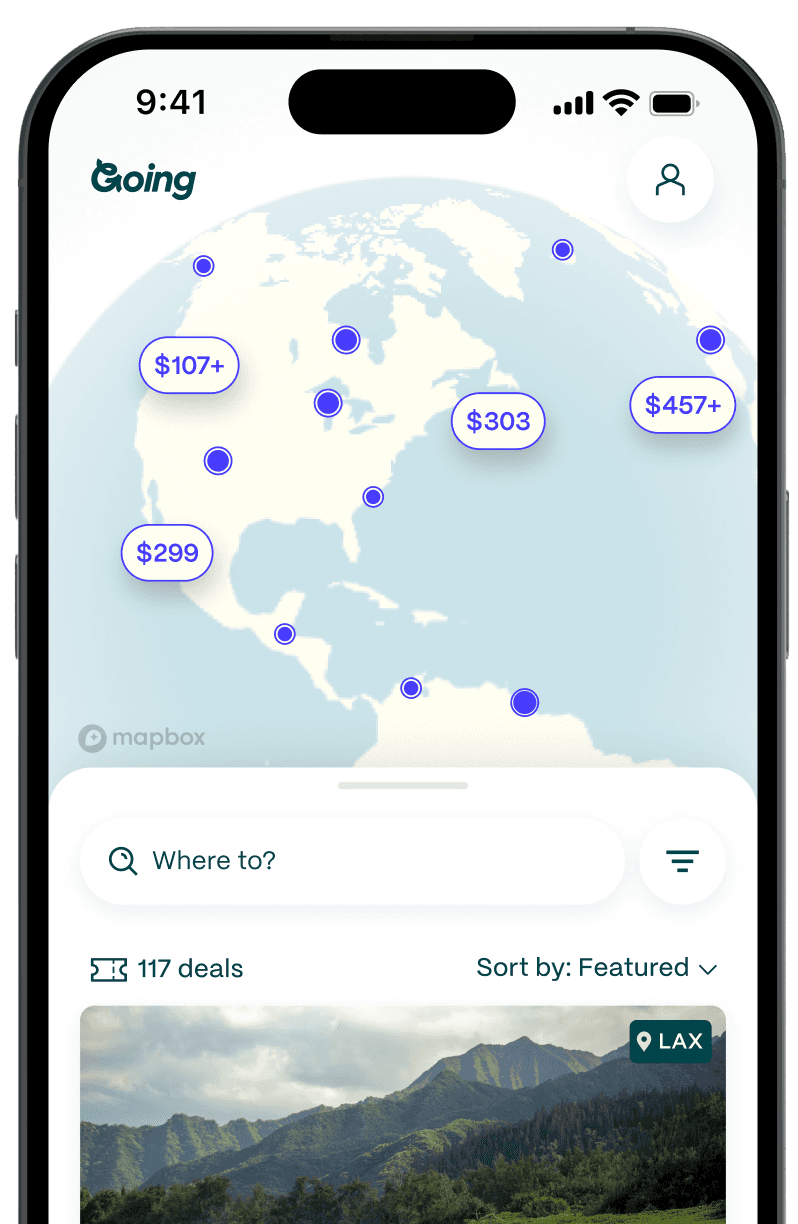
Google Flights Price Alerts: How To Make Them Work for You



September 23, 2026
4 min read
Table of Contents
If you’ve ever booked a flight and then watched the price drop days later, you know the feeling. A sinking, “I should’ve waited” feeling. Airfare changes constantly, and without help, it can feel impossible to know when to book—or when to wait.
That’s exactly where Google Flights alerts come in. Instead of refreshing search results or guessing on timing, Google Flights lets you track prices and notifies you when fares change. Used correctly, these alerts can take much of the stress—and guesswork—out of booking flights.
In this guide, we’ll break down how to set alerts on Google Flights, what they’re good at, where they fall short, and how to combine them with other tools (including Going) to consistently get better deals.

What are Google Flights alerts?
Google Flights alerts are automatic price-tracking notifications that monitor airfare for specific routes or flights and notify you when prices change. You can set alerts for:
- A general route (e.g., NYC → Paris)
- Specific travel dates
- An exact flight itinerary
Once activated, Google tracks prices in the background and sends updates via email, or through the Google Flights alerts app experience if you’re logged into your account.
How Google Flight alerts work
Behind the scenes, Google Flights uses historical pricing data and real-time fare changes to monitor flights. When a price drops (or sometimes rises significantly), you’ll get a notification.
These alerts don’t predict the future perfectly, but they’re excellent at reacting quickly when prices move.
Benefits of using flight price alerts
Google Flights alerts are especially useful because they:
- Require almost no setup time
- Track prices automatically
- Reduce the need to check fares daily
- Work for both domestic and international routes
They’re one of the simplest answers to how to set up Google alerts for cheap flights without needing third-party tools.
Limitations of Google Flights alerts
That said, they’re not flawless. Google Flights alerts:
- Don’t surface mistake fares proactively
- May miss ultra-short-lived flash sales
- Don’t always explain why prices changed
- Track prices, but don’t tell you whether a deal is truly rare
This is why alerts are most effective when paired with broader deal discovery tools, such as the Going app.
Why use Google Flights for price tracking?
Google Flights price alerts notify you by email whenever a fare changes on a route you're tracking — but the tool has real limitations worth knowing before you rely on it.
What Google Flights alerts do well:
- Track price changes on a specific route and date combination
- Show price history graphs across different travel windows
- Allow simultaneous tracking of multiple routes from one dashboard
What they don't do:
- Alerts are not instant — meaning flash sales and mistake fares (accidental pricing errors that can be 50–90% below normal) are often gone before a notification arrives
- Only work on fixed dates and destinations — you can't, for example, track all flights to Europe in March without specifying exact dates and cities
For travelers with flexible dates and a primary goal of finding the lowest possible fare, a dedicated flight deal service like Going complements Google Flights by catching deals that fixed-route alerts miss.
For starters, these alerts are not instant. This means you miss the chance to catch a mistake fare (an accidental discount on a flight far below what the airline intended). Another drawback is that it only works on fixed dates and destinations. So you can’t, for example, set an alert for the month of February for all the Caribbean.
That’s why if you’re not constrained by travel dates and your main goal is to score the lowest possible fare, there are even better ways to stay in the loop for great deals (like the Going app). However, if you’re interested in following a trip with a certain departure and destination and certain dates, setting up alerts on Google Flights can help you keep track of the prices.
If you’re still learning the timing side of airfare, Google’s insights pair well with broader guidance like Going’s guide to the best time to book with Google Flights. Whether you’re looking to explore new destinations or secure the best price for a planned route, Google Flights and Going are valuable tools to make budget-friendly travel a reality.
Step-by-step guide to setting up Google Flights alerts
When it comes to how to set price alerts, Google Flights is pretty straightforward.
Step 1: Log in to your Google account
Price tracking only works when you’re logged into your Google account. This allows Google to:
- Save your alerts
- Send email notifications
- Sync alerts across devices
Step 2: Enter your flight information
Explore the flight options. For more information, you can check our guide and learn how to use Google Flights. Once you have decided on your destination and dates, enter the details of your trip:
- Select your departure and arrival cities. Google Flights can track fares from multiple airports, so you can input several nearby airports to increase your options.
- Pick your travel dates. For more options, explore flexible dates.
- Remember to add the number of travelers you need to get a price estimate for the whole party.
- What’s your trip type? Are you going on a roundtrip, one-way, or multi-city trip?
| Note: Google Flights alerts show price changes. Going alerts show deals. Big difference. |
Step 3: Adjust your filters
Before setting alerts, refine your search:
- Cabin class
- Number of stops
- Airlines
- Baggage preferences
If you want to avoid restrictive fares, consider excluding basic economy using our guide: How to exclude basic economy on Google Flights.
Step 4: Activate price tracking
Toggle “Track prices” near the top of the results page.

Track prices for a route
Google Flights offers two distinct ways to activate price tracking, depending on how specific your travel plans are.
Option A — Track a route (flexible travelers):
Toggle "Track Prices" on the left side of the search results page. This monitors all flights between your chosen cities and dates, sending alerts whenever any fare on that route changes significantly.
Option B — Track a specific flight (fixed itinerary):
Click on the exact flight you want, as if you were about to book it. On the flight detail page, toggle "Track Prices" on the right side. This locks tracking to that specific airline, departure time, and routing.
Which to use: If your dates and destination are flexible, Option A casts a wider net and is more likely to surface a lower fare. If you've already decided on an exact itinerary, Option B keeps you informed about that specific flight's price movement.

Track prices for a specific flight
Instead, if you have a particular flight in mind, select the specific flights you want to take by clicking on them (like you want to book them). You’ll be redirected to a page to select the airlines.
Now, you can toggle the “Track prices” button for that flight (this time it’s on the righthand side) to get alerts specific to that airline, departure time, and other details. This helps you lock in the best price for the exact itinerary you want.
Step 5: Get price alerts
Once you’ve started tracking your desired flights, you will find out every time the flight you chose changes prices, for better or for worse. Additionally, you can choose to receive a list of alternative flights that you may want to take a look at instead. In fact, you can activate alerts for all of them at once in order to track and find the cheapest one.

Step 6: Monitor price trends
Other Google Flights tools can help you visualize fare trends. Price Graph and Date Grid let you compare prices across different months or weeks, giving you a clear picture of the best times to travel.
If you’re open to different destinations, try using the Google Flights Explore Map. Simply enter your departure city and leave the destination open, or select a specific region like Europe or South America.
Step 7: Adjust or pause tracking
Managing your flight alerts is simple. If your travel plans shift, you can modify your tracked routes by selecting a new flight or updating your search preferences. If you access the “My Trips” section, you’ll see all your alerts. From there, you can click the toggle switch below the price graph to pause alerts temporarily, stopping notifications for as long as you need.

Step 8: View all tracked prices
To monitor all the routes you’re tracking, go to the menu on Google Flights and select “Tracked flight prices.” This section displays a complete list of your tracked routes, along with their price history graphs. Here, you can review trends and manage multiple alerts in one convenient place. Checking this section regularly can give you an idea of fare fluctuations across all your tracked flights.

How to manage your Google Flights alerts
Viewing all your active alerts
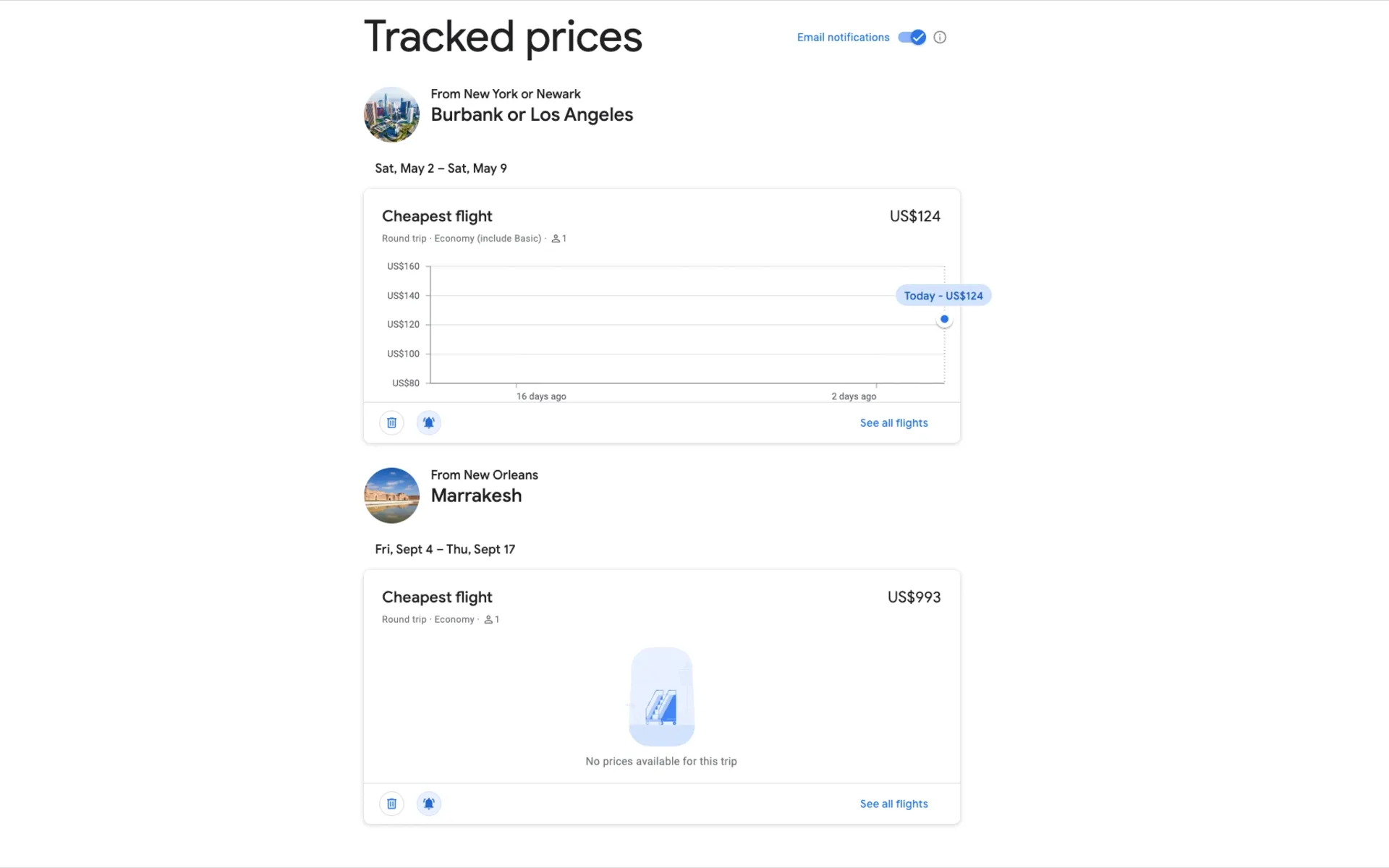
From Google Flights, click Tracked prices to see every route and flight you’re monitoring in one place.
Editing or deleting alerts
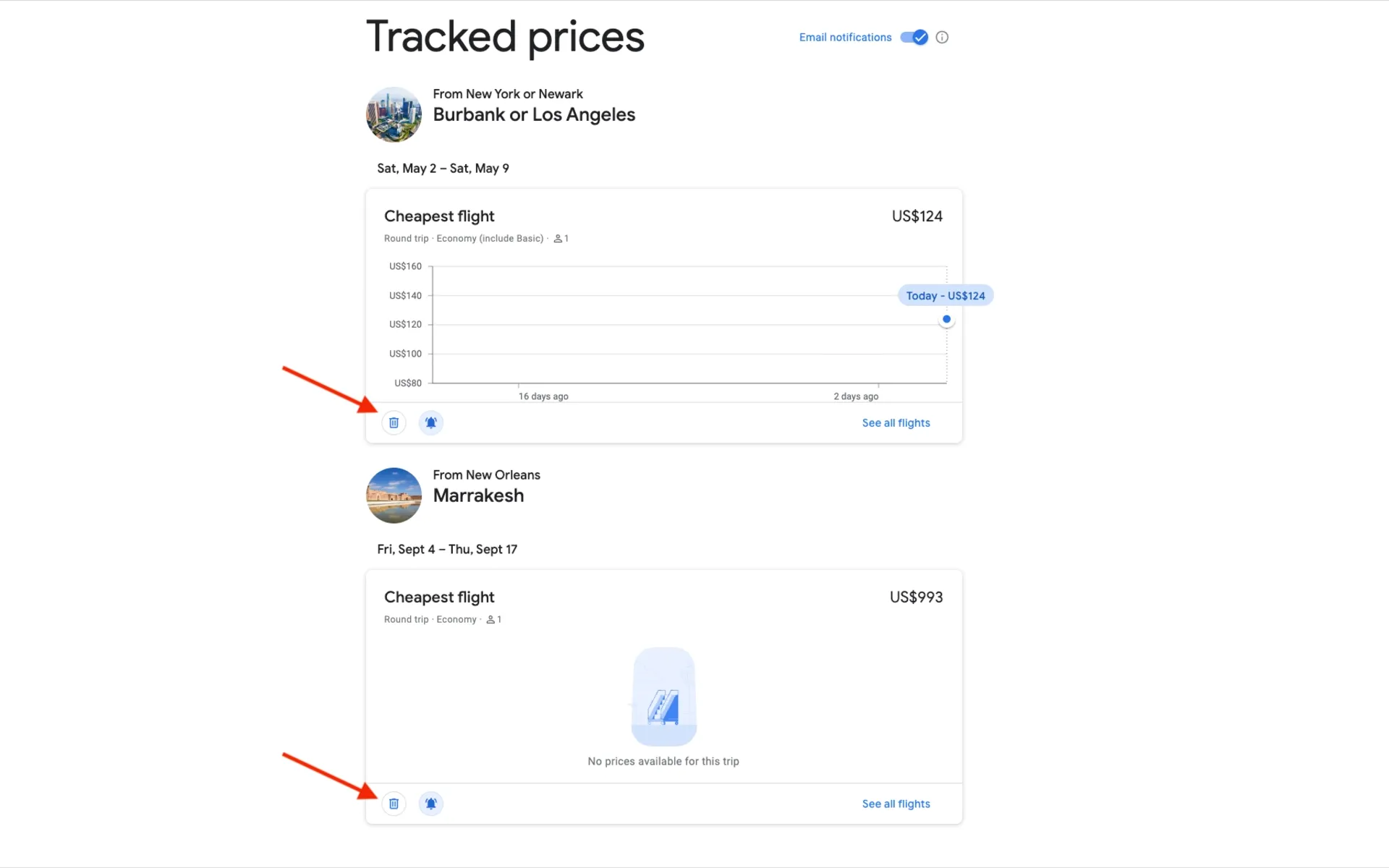
You can turn alerts off anytime. Deleting old alerts helps avoid inbox clutter and confusion.
Understanding email notifications
Not every alert means “book now.” Some alerts flag price increases, others minor drops. Always click through to see the full context.
Google Flights alerts vs other price tracking tools
Google Flights vs KAYAK alerts
Kayak alerts can be helpful, but they’re often slower and less contextual. Google Flights provides better historical comparisons and cleaner notifications.
Google Flights vs Going alerts
This is the key distinction:
- Google Flights alerts react to price changes on routes you’re already watching
- Going alerts proactively surface mistake fares, flash sales, and rare deals you’d never think to track. Plus, with Price Drop, we keep tracking your flights even after you book, so you can reclaim savings if fares drop anytime before departure.
For example, Google won’t tell you a $350 Europe fare is unusual—but Going will.
You can also combine alerts with strategies like self-transfer itineraries (Google Flights self-transfer guide) or comfort tools like legroom data (Legrooms for Google Flights).
When to use each tool
Here is the best approach:
- Going → discover deals worth caring about
- Google Flights alerts → track price movement
- Price guarantee → protect you after booking (Google Flights price guarantee)
- Going Price Drop → Going tracks fare drops after you book, so you can rebook and save
Additional cost-saving strategies
Setting up price alerts is just one way to secure a cheap flight. You can check our flight hacks guide for other tricks. In the meantime, here are some key tips to save even more.
Booking within the Goldilocks Window
For the best deals, aim to book flights 1–3 months before domestic travel and 2–8 months before international trips. The Goldilocks Window is the sweet spot where airlines tend to offer competitive prices. Remember that peak season requires even earlier booking, so plan accordingly. Avoid booking at the last minute, as airlines tend to charge higher prices the closer you get to the day of the flight.
Tracking flexible dates and routes
One of the best ways to find great deals is by staying flexible with your travel dates and even your destination. Google Flights’ flexible date tool makes this easy by showing how shifting dates impacts prices. When you’re open to various travel dates, you can set up Google Flights alerts without a fixed timeframe, giving you a wider range of options.
Changes in your route can also impact your flight fare. Most times, adding a layover can lead to a cheaper flight. Options with layovers or multi-city routes can often be cheaper than direct flights, particularly for international trips.
Using nearby airports for additional savings
If you’re open to nearby airports, consider adding alternative departure and arrival locations in your search. For example, if you live in Los Angeles, try tracking flights from surrounding airports like LAX, Burbank (BUR), and San Bernardino (SBD) to maximize potential savings. Sure, you might have a short ride to your final destination, but you can also save hundreds.
Using points and miles to reduce costs
Take advantage of frequent flyer programs to save on flights. If you sign up for your preferred airline’s loyalty program, you can start accumulating miles through flights and travel partnerships. Once you've collected enough miles, you can redeem them for free flights or upgrades.
If you have a credit card that earns points, you can also use them for your trips. Instead of redeeming your points for cash back—which generally offers a low return—you can use them to book flights or transfer them to frequent flyer programs. For more details on credit card points and airline miles, take a look at our guide to credit card points and airline miles.
Change your currency
Google Flights automatically detects your location and sets the language and currency accordingly, but sometimes, this can work against you. Luckily, you can manually change these settings and ensure the rate works in your favor.
Switching to the local currency when booking with foreign airlines might save you money due to exchange rate differences. Just remember to use a credit card that doesn’t charge foreign transaction fees.
Troubleshooting common issues with Google Flights alerts
Not receiving alerts
Check that you’re logged into your Google account, your alerts are turned on, and your emails aren’t filtered. These are common mishaps that keep travelers from receiving alerts.
Alerts showing higher prices than expected
Sometimes alerts notify you of increases—not drops. Always verify before pulling the trigger and buying the flight.
How to fix "ghost fares"
Ghost fares happen when prices change faster than results update. Refresh and verify directly with the airline before booking.
Maximize savings with Going's expert flight deal
Setting up Google Flights alerts is a great way to monitor standard fares, but Going takes your search to the next level. While search engines track specific routes, Going surfaces rare deals, such as mistake fares and flash sales, that can save you up to 90% to destinations you might not ever have thought to visit. Plus, with Price Drop, we keep watching your fare after you book. We’ll tell you when the fare falls and give you the tools to pocket the savings.
Price Drop monitors your booked flight until departure, instantly alerting you with simple steps to rebook with the airline and reclaim the difference.
Members save an average of $150 per flight with Price Drop. Your itinerary, seat selection, and departure time remain untouched—you stay in charge and claim the refund directly with the airline.
By combining real-time deal alerts before booking with Price Drop tracking afterward, Going is the perfect tool to complement Google Flights.
Start by setting up a trip in Going app, and we’ll find deals that’ll inspire you to book. Then, add your booked flight to Price Drop, and we’ll keep monitoring your fare for savings. With Trips and Price Drop, Going helps you get the best price before and after you book.
Related reading:
Frequently asked questions
Can I set alerts on Google Flights?
What is the best flight alert app?
Does Google do price alerts?
How to tell if a flight price will go down?
Is Google Flights the best flight tracker?
How to fix Google Flight alerts not working?
What is the best free flight tracker?

Last updated September 23, 2026
Articles you might like
View All