Cheap Flights For Students: The Golden Strategy For Discounted Student Tickets



July 13, 2026
10 min read
Table of Contents
Yes, students can get cheap flights, and more reliably than most realize. The key is knowing where the discounts are hiding (and where they aren’t), which platforms negotiate fares the public can't access, and how to set yourself up to catch deals the moment they drop.
This guide covers all of it: the student-specific booking platforms, the one major US airline with a specific young adult discount, the advanced strategies frequent travelers use, and the tools that do the searching for you. If you are a college or university student looking to fly on a budget in 2026, here’s what you need to know.
Key takeaways
- Going members receive flight deal alerts, including mistake fares as much as 90% cheaper than standard prices.
- CheapAir's annual airfare study says the prime booking window for domestic flights is 21–74 days before departure (42 days being the sweet spot), but Going recommends looking and booking a bit earlier: 1–3 months ahead for domestic travel and 2–8 months ahead for international travel.
- Student-specific platforms like StudentUniverse (now BYOjet) and the ISIC card unlock fares unavailable on mainstream booking engines.
- United Airlines is the only major US carrier with an app-exclusive Young Adult Discount (5% off, ages 18–23). Other airlines, such as Delta, American, and JetBlue, offer student-accessible fares primarily through third-party platforms like ScholarTrip and BYOjet.
- Advanced strategies (e.g., hacker fares, split-ticketing, and hidden-city ticketing) can cut costs significantly when used correctly, but there are things to be aware of for each.

How to get cheap flights for students: 5-step framework
Not all savings strategies are equal. Follow this five-step sequence to stack every available discount before you book.
Start with flexible dates and airports
The day you fly matters. The day you book, less so. According to Going data, Tuesday, Wednesday, and Saturday departures tend to be the cheapest, with international midweek flights running 10–20% lower than peak-day departures (Friday and Sunday). Business and leisure travelers flood flights around the weekends (Mondays, Thursdays, Fridays, Sundays), and that demand pushes prices up. If you can shift your departure by even one or two days, the savings can be significant.
The old advice about a "cheapest day to book" (book on Tuesday, use incognito mode, wait for National Cheap Flight Day) is a myth. We have a guide that debunks all of it: Airline pricing updates continuously, multiple times per day, based on demand algorithms, not your browser history or the day of the week.
The most effective tool for finding the cheapest departure window is the monthly calendar view. On Google Flights, switch to the date grid or price graph view to scan an entire month at a glance. You’ll often find a $50–$100 difference between midweek and weekend departures. Skyscanner's "whole month" view works the same way.
Flexibility with airports is equally valuable. We encourage travelers to check nearby airports, one of the most underused savings levers, especially when secondary airports are served by budget carriers that get overshadowed at major hubs. Flying into Newark (EWR) instead of JFK, or London Gatwick (LGW) instead of Heathrow (LHR), can save $50 to $200 per leg. Factor in ground transport costs to ensure the airfare savings are worth the effort.
Use student-specific platforms first
Before checking mainstream sites, run your search through platforms built exclusively for student travelers, such as StudentUniverse, ScholarTrip, and StudentBeans. These platforms negotiate exclusive fares with airlines that you won’t find on Expedia or Google Flights. They often require proof of enrollment (like a .edu email or uploaded student ID), but the discount can more than justify the extra step.
Layer airline loyalty and student discounts
Sign up for the loyalty program of every airline that serves your regular routes. It’s free and takes five minutes. Even if you only fly twice a year, miles accumulate. United Airlines, in particular, has a dedicated Young Adult Discount for MileagePlus members ages 18–23 (see the Airlines section below).
Set fare alerts ASAP
Don’t wait until you have a specific travel date locked in before setting alerts. Flight deals appear all the time and disappear within hours. The sooner your alerts are active, the better your chances of catching one.
Set alerts on Going and Google Flights (Hopper also has a version) as soon as a trip is on your radar. Going's Premium and Elite memberships automatically scan millions of fare combinations daily and push alerts only when a price is exceptional, not just marginally cheaper. When a deal fires, we’ll find it first, and we’ll let you know when it’s time to book.
Book at the right moment
Once an alert fires and the fare meets your budget, book as soon as possible. Cheap seats are released in small batches. Hesitating means you may return to find the price has jumped because someone else has already snagged the lowest fare. If you’re torn, check the airline's change and cancellation policy. Many now offer free 24-hour holds or no-fee changes on select fares.
Best apps and websites to find cheap flights
The platform you use matters as much as when you search. Here’s how to get the most from each category.
Deal aggregators: Going
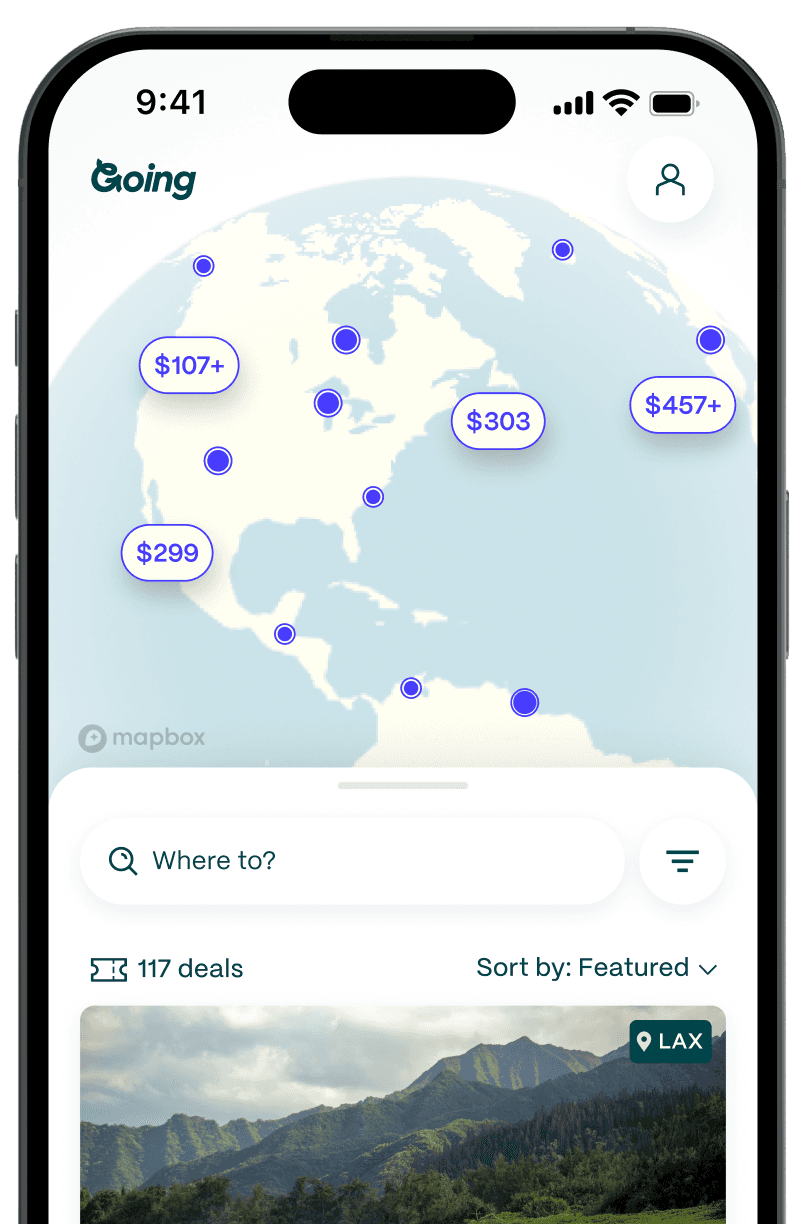
Going (formerly Scott's Cheap Flights) is the gold standard for flight deal alerts. Unlike metasearch engines, we don’t make you search. We do the searching for you. Our team of flight experts monitors thousands of routes around the clock and alerts you when fares drop, including mistake fares that airlines briefly and accidentally publish at a fraction of the correct price.
Free members receive deal alerts for domestic flights only. Premium members get unlimited economy deal alerts for international flights, too, plus points and miles deals. Elite members unlock business and first class deal alerts as well. For students who travel even twice a year, the membership pays for itself on the first booking.

Metasearch engines: Google Flights, Kayak, Skyscanner, Momondo
Metasearch engines aggregate fares from airlines and online travel agencies in real time. Each has a distinct strength:
- Google Flights: Best calendar and price-tracking tools. The "Explore" map is ideal when your destination is flexible.
- Kayak: Strong price forecasting ("Buy or Wait" feature) and flexible search filters.
- Skyscanner: Excellent "Everywhere" destination option for inspiration; strong for international budget carriers.
- Momondo: Often surfaces smaller regional airlines that other engines miss, particularly in Europe.
Use at least two of these for any search. Prices can differ by $20 to $80 on the same flight depending on which OTA is selling the ticket.
Prediction tools: Google Flights Price Guarantee and Hopper
Hopper uses historical data and machine learning to predict whether a fare will rise or fall with up to 95% accuracy, analyzing 25 to 30 billion price quotes every day. Its "Watch a Trip" feature monitors your route 24/7 and alerts you when prices drop or are expected to rise. Google Flights offers a similar Price Guarantee on some routes. If the price drops after you book, Google refunds the difference.
These tools are useful for planning ahead, but they work best in combination with Going's real-time alerts. A prediction engine tells you when to buy a normal fare; Going tells you when an extraordinary deal appears.
Student discount on flights: platforms that work
These companies negotiate directly with airlines on behalf of students. Always check them before booking on a general site.
StudentUniverse (now BYOjet for Students)
StudentUniverse (rebranded under the BYOjet for Students umbrella) is the largest student travel booking platform in the world. It offers verified student fares on hundreds of routes, often 10–25% cheaper than the best average available price. You will need to verify your student status with a .edu email or student ID. Fares are typically age-restricted (under 26 or 30, depending on the route) and may carry different baggage or change policies than standard tickets.
StudentBeans and the ISIC card
StudentBeans is a discount network that partners with brands across retail, food, software, and travel. Several airlines and booking platforms offer exclusive promo codes through StudentBeans, redeemable with a verified student account.
The International Student Identity Card (ISIC) is the only internationally recognized proof of full-time student status, issued in nearly 130 countries and unlocking access to more than 150,000 discounts and benefits worldwide. Beyond flight discounts (through affiliated booking partners), the ISIC unlocks museum entries, hostel rates, and travel insurance discounts. An annual ISIC card costs around $25 and can return its value many times over on a single trip.
ScholarTrip
ScholarTrip positions itself as a student-first travel booking engine with curated package deals that bundle flights, accommodation, and activities. It is particularly ideal for group travel. If you’re organizing a class trip or going abroad with friends, ScholarTrip's group booking tools can simplify coordination and unlock volume discounts. ScholarTrip also surfaces discounted student fares on Delta, American Airlines, and other major carriers that are not available directly on those airlines' own websites.
MyTrip and Travelosophy
MyTrip aggregates fares from dozens of airlines and OTAs and occasionally surfaces student-priced tickets through airline partners. Travelosophy is a newer one focused on budget-conscious travelers, with curated deal collections that skew toward student-friendly routes (transatlantic, Southeast Asia, Latin America). Neither replaces the dedicated student platforms, but both are worth a quick check when comparing prices.
Airlines with student discounts in 2026
When it comes to airline-level student discounts, it’s important to distinguish between dedicated programs that airlines themselves run and fares that are only available through third-party student platforms, such as StudentUniverse or ScholarTrip. Only one major US airline currently offers a direct, self-service discount for young travelers.
United Airlines: Young Adult Discount (direct)
United is, according to its website, "the only major US airline offering young travelers a discount." The Young Adult Discount gives MileagePlus members ages 18–23 a minimum 5% off United economy and basic economy fares, with discounts on close-in bookings sometimes reaching 60% or more on certain routes, according to The Points Guy.
To access it, download the United app, log into your MileagePlus account (free to join), select the "Young Adult Discount" option when searching for flights, and the discount applies automatically at checkout. The discount is available on United and United Express flights originating in the US, select international routes, and codeshare flights operated by Air Canada, ANA, Austrian, Brussels Airlines, Lufthansa, and Swiss. Note that it applies to one traveler per reservation only and is not available on the United website (app required).
Learn more about the United Airlines Young Adult Discount.
Delta SkyMiles (not direct)
Delta Air Lines does not offer a dedicated student discount program on delta.com. Their official Fares & Discounts page lists bereavement fares, military fares, and senior discounts in certain markets but no student pricing. Delta student fares are accessible exclusively through third-party platforms such as ScholarTrip and StudentUniverse, which have negotiated agreements with Delta to surface discounted fares for verified students.
That said, SkyMiles is free to join, and earning miles on every Delta flight adds up over time. Delta also runs periodic promotions that may benefit student travelers.
Learn more about Delta Fares & Discounts.
American Airlines AAdvantage (discounts through third-party partners)
American Airlines does not advertise a publicly available student discount program on aa.com. However, discounted student fares on American flights are accessible through StudentBeans (via verified promo codes) and through ScholarTrip, which lists American among its partner airlines. Students who verify their status on these platforms can access fares about 10–20% off on select domestic and international routes.
Similar to Delta, these are partner-mediated discounts rather than a program you can access directly on American's own booking engine.
Learn more:
- Does American Airlines Offer Student Discounts? (Simple Flying)
- American Airlines Student Discount (ScholarTrip)
JetBlue TrueBlue: (loyalty program, not direct)
JetBlue does not currently offer a direct student discount program for US-based travelers. (A student travel program offering reduced fares exists for UK departures through select travel agents, but it’s not available for domestic US travel or flights originating in the US)
What JetBlue does offer to any traveler, students included, through its free TrueBlue loyalty program: no blackout dates on reward bookings and points that never expire, making it a good fit for students who fly infrequently. JetBlue also partners with StudentUniverse, through which verified students can sometimes access discounted fares and additional baggage allowances on JetBlue flights.
Learn more:
Airlines comparison table
| Airline | Student discount type | How to access | Key benefit |
| United | Direct (app-exclusive) | United app, MileagePlus account, ages 18–23 | 5% off minimum; up to 60% on close-in bookings |
| Delta | Via third-party platforms | ScholarTrip, StudentUniverse | Student fares not available on delta.com |
| American | Via third-party platforms | StudentBeans, ScholarTrip | ~10–20% off select routes |
| JetBlue | Via TrueBlue and StudentUniverse | Free TrueBlue membership; StudentUniverse for student fares | No blackout dates, points never expire |
Going members received deal alerts to Europe for less than $300 this year. See deals currently available now.
Extra tips to save as a student
Once you’ve exhausted the standard options, these advanced strategies can unlock additional savings.
Mistake and error fares
Due to currency conversion errors, data entry mistakes, technical glitches, or otherwise, airlines occasionally publish fares at a fraction of their intended price . These, what we call, mistake fares can be 70–90% below the actual price and are only live for a few hours before the airline corrects them. Going's team monitors these around the clock and alerts members the moment one appears. If you receive a mistake fare alert, book immediately, figure out the logistics after, then employ the 24-hour rule if you need to.
Hidden-city ticketing
Booking a hidden city fare, also called point-beyond ticketing or skiplagging, is when you buy a ticket to a point beyond where you actually want to go. Your ticket lists one destination but the city you actually want to visit is the layover city on the way. You book a flight from A to C with a layover in B, with the intention of staying in city B. It’s legal, but it violates most airlines' terms of service, so use it selectively, never check luggage when doing so, and avoid it with loyalty accounts you care about. NerdWallet covers the risks in detail.
Multi-city searches vs. roundtrip
Not all the time, but sometimes, booking two separate one-way tickets is cheaper than a roundtrip on the same airline, particularly when you’re flying domestically, mixing carriers, or flying in and out of different cities. A classic student itinerary: Fly into London on Norwegian, take the train through Europe, and fly home from Lisbon on TAP. Build this as two one-ways rather than a roundtrip and you can save hundreds. Skyscanner's multi-city search tool makes this easy to price out.
Hacker fares and split-ticketing
Hacker fares (a term popularized by Kayak) combine two one-way tickets from different airlines into a cheaper combined itinerary than any single carrier offers. The trade-off: You’re responsible for your own connection if one leg is delayed. Split-ticketing is a similar concept where you purchase separate tickets for each leg of a longer journey. Both strategies require more coordination but can save $150 to $400 on transcontinental or transatlantic routes.
The Greek Islands Trick
The idea: Flights directly to Greek island airports (Mykonos, Santorini, Rhodes) are significantly more expensive than flights to Athens. The savvy move: Book a cheap transatlantic fare to Athens, then connect via a budget carrier (Ryanair, Aegean, Sky Express) or a short ferry. The total cost is often $200 to $400 less than flying direct to the islands. The same principle applies to Croatia (fly to Split via Vienna rather than directly), Portugal's Azores (fly to Lisbon first), and many other destinations around the world.
Let Going find the deals for you, and start flying for less today
One of the most effective things a student traveler can do is join Going. Instead of spending hours yourself searching and comparing fares, Going's experts do the work, scanning millions of fare combinations daily and alerting you only when a great deal shows up from your home airport.
Free Limited members get domestic deal alerts. Premium and Elite members get unlimited alerts on economy, business, and first class fares, plus access to Going's exclusive mistake fare notifications, as well as points-and-miles deals.
Students who book even one Going deal per year save far more than the membership fee. If you’re planning a semester abroad, a summer backpacking trip, or just want to be ready when the right deal appears, there’s no better tool for the job.

Frequently asked questions
Do students really get discounts on flights?
Yes, though the picture is more nuanced than most guides let on. United Airlines is the only major US carrier with a dedicated, self-service young adult discount (5% off for MileagePlus members ages 18–23, via the United app). For Delta, American, and JetBlue, student-priced fares exist but are negotiated and distributed through third-party platforms like StudentUniverse, ScholarTrip, and StudentBeans, not directly through the airlines' websites. Combined with a service like Going that surfaces deal fares, students can fly for significantly less than most travelers pay.
How far in advance should students book flights?
We encourage students to book flights within the Goldilocks Window: 1–3 months out for domestic travel and 2–8 months out for international travel. For peak seasons, such as summer, winter holidays, and spring break, add a couple of months to each of those windows.
According to CheapAir's annual airfare study, the prime booking window for domestic travel is 21 to 74 days before departure, with 42 days being the optimal point. For international flights, CheapAir's international study recommends booking further out, though the exact window varies by region. The exception is mistake fares and flash deals, which require immediate booking whenever they appear.
Setting alerts on Going ensures you never miss these time-sensitive opportunities.
What's the cheapest month to fly to Europe as a student?
January and February (outside of the New Year’s holiday) are consistently the cheapest months for transatlantic flights. Fares from major US hubs to London, Amsterdam, and Paris can drop below $400 roundtrip (even below $300 if you know when and where to look).
November and early December (before the holiday surge) are also great windows. Avoid late June through August if budget is the priority. Summer is peak season and fares reflect it. Going's deal data consistently shows winter as the best season for transatlantic bargains. If your schedule is flexible, a January or February trip to Europe can cost half what you would pay in July.
Last updated July 13, 2026