


Table of Contents
The best way to start traveling is to keep your first trip simple: Pick an easy destination, pack light, and sort out your money, safety, and flights before you go. Do that, and you’ve already dodged what trips up most first-timers.
Your first trip can feel like a hundred decisions stacked on top of each other. Where do you go? What do you pack? How do you avoid the exorbitant bag fee that nobody warned you about? You’re not alone. Almost every beginner makes the same handful of mistakes. Luckily, most of them are avoidable.
We’ve spent more than ten years finding cheap flights for first-time travelers and getting them out the door, which is the whole idea behind Going’s deal alerts. Here are our tips for you.

Key takeaways
- Start with an easy destination. A short-haul flight or a neighboring country beats a 14-hour trek for your first trip.
- Pack smart. Stick to what you need. Most beginners bring too much, then drag it through five train stations.
- Set up a fare alert instead of refreshing fares. Prices change daily. Checking them constantly is exhausting. Let the experts do it for you.
- Notify your bank, and carry two cards from two different banks. If one gets blocked, you’re not stuck without money.
- Enroll in STEP before you fly internationally. The US State Department’s free service sends you safety updates and helps the nearest embassy find you in an emergency.
Start with an easy destination
For your first trip abroad, pick somewhere easy: a domestic flight or a short hop to Mexico, Canada, or the Caribbean. It builds confidence and teaches you the basics of airports, customs, and being away from home without throwing you into the deep end.
The US State Department maintains travel advisories for every country, ranked 1 through 4. Check the advisory level before you book. Most popular tourist destinations in Mexico, the Caribbean, and Western Europe sit at Level 1 or 2, which means “exercise normal precautions” or “exercise increased caution,” though general travel still tends to be okay.
Tip: If you’re nervous about international travel, start with a destination where English is widely spoken. London, Dublin, or a Caribbean resort area like Punta Cana are all gentle entry points.
How to plan your first trip without overthinking it
A lot goes into planning a trip, but three big questions should be top of mind: where, when, and how much. Sort those out, and you’ve done the hard part.
A smart way to save is to pick your dates based on shoulder season, the weeks just before or after peak tourist season. You’ll find lower prices, fewer crowds, and weather that’s usually perfectly lovely. For Europe, that means April to mid-June or September to October. For Southeast Asia, avoid the monsoon months (typically June to October depending on the country).
For flights, the biggest beginner mistake is refreshing fare sites every day hoping prices will drop. They might. They also might go up. We’ve seen roundtrip fares to Lisbon jump from $312 to $580 in 48 hours. The smarter move is to set up a fare alert, and let the deals come to you.
Tip: If seeing the major attractions in a destination is important to you, book tours before you travel. Popular sites like the Colosseum in Rome or the Anne Frank House in Amsterdam can sell out weeks ahead, especially during peak season. Walk-in tickets are often unavailable or cost more.

Pack less than you think you need
Pack about half of what you think you need. Beginners pack for every possible scenario. Seasoned travelers plan ahead, pack for about half the days they’ll be there, and plan to do laundry or mix and match articles of clothing.
Here’s a checklist that can work for trips up to two weeks:
- 5 tops (mix of t-shirts and at least one nicer shirt)
- 3 bottoms (jeans, shorts, and something for a dinner out)
- 7 pairs of underwear and socks
- 1 light jacket (even in summer, for planes and AC)
- 1 pair of walking shoes (wear them on the plane)
Another tip is to roll your clothes instead of folding them. You’ll fit more into the bag, and your clothes will wrinkle less. If you’re checking a bag, weigh it before you get to the airport. Most airlines charge around $100 or more per bag each way for bags over 50 pounds ($200 or more for bags 70+ pounds). The worst thing is being caught off-guard at bag drop and either having to pay for the excess or trying to reorganize your belongings so the bag isn’t overweight.
Keep your passport, medications, chargers, and a change of clothes in your carry-on. Checked bags get delayed. The TSA’s 3-1-1 rule limits liquids in carry-on bags to 3.4 ounces per container, which all must fit in one quart-sized bag. Tons of travelers get this wrong every day and end up losing their sunscreen, lotion, or contact solution at security.
Money and safety: don’t get caught off guard
Two things ruin a first trip faster than anything else: a blocked credit card and a stolen phone.
Most banks let you set a travel notice through their app. If you don’t, their fraud system may flag your first purchase abroad and freeze the card. Make sure to notify your bank of your travel plans, but as an extra precaution, carry at least two cards from two different banks, kept in separate places. If your wallet gets lifted, you still have a backup.
Use a no-foreign-transaction-fee card. Cards that charge foreign transaction fees typically add 2–3% to every purchase. On a $1,500 trip, that’s $30–$45 you’re giving away. Many travel credit cards waive this fee entirely.
Enroll in STEP. The Smart Traveler Enrollment Program is free. You register your trip with the nearest US embassy or consulate, and they send you safety alerts about your destination. If there’s a natural disaster, civil unrest, or a family emergency back home, STEP is how the embassy knows where you are.
A smart traveler waits until they’re back home to share photos. Posting “Loving Costa Rica!” tells everyone you’re not at home. It’s a small risk, but it’s a free one to avoid.
Mistakes when booking your flight
Booking a flight is where beginners lose the most money. Here are the three errors we see most.
Booking too early or too late
Domestic fares tend to be cheapest 1–3 months out, and international fares 2–8 months before departure. Book too early, and you pay the initial price before airlines adjust. Book too late, and you’re competing with business travelers who pay whatever it costs. We cover the details in our guide to when flight prices drop.
Ignoring budget airline fees
Low-cost carriers like Frontier and Allegiant offer base fares that look too good to be true. They are cheap, but they charge for everything else: carry-on bags ($35–$65), seat selection ($10–$45), and even water. Compare the total cost, not the headline fare. Our breakdown of the best and worst budget airlines walks through which ones are worth it.
Booking the wrong day to fly
There’s no magic “cheapest day to book,” despite what you’ve heard. What does matter is the day you fly. Tuesday and Wednesday departures are typically cheaper than Friday and Sunday for domestic routes.
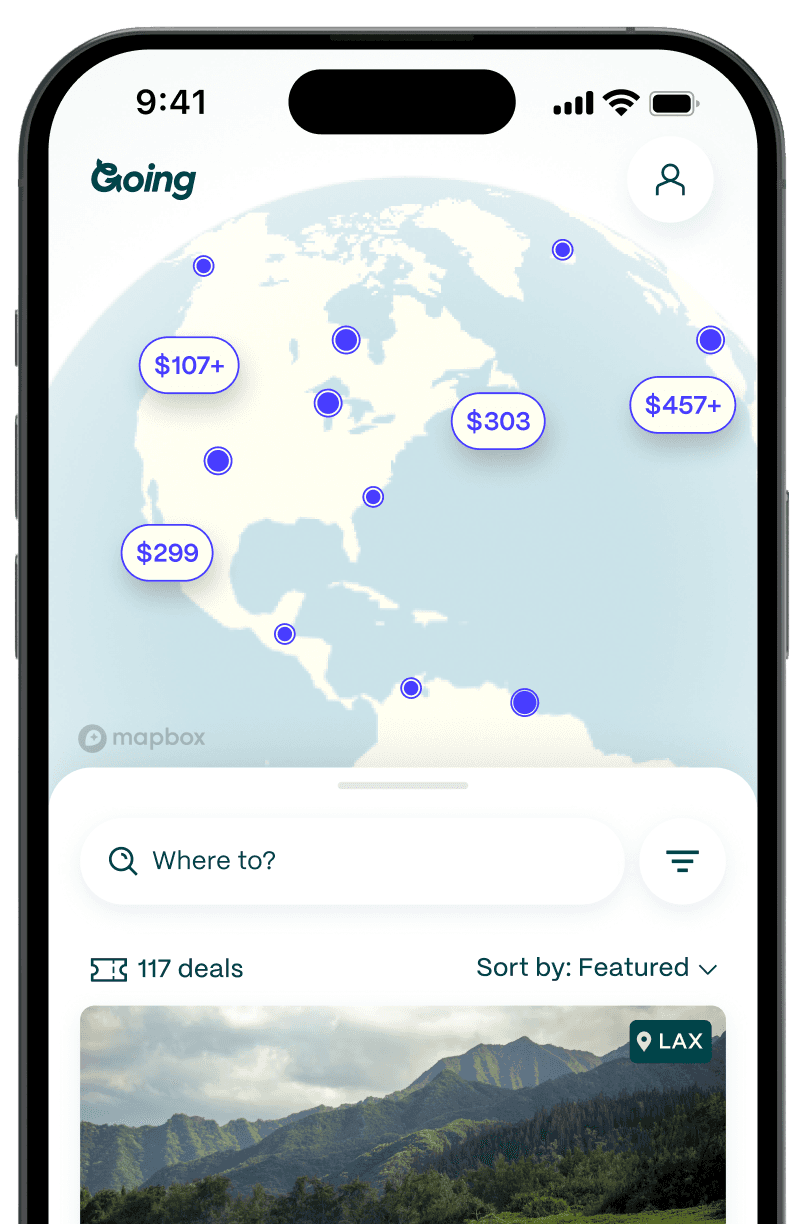
If you don’t want to track all of this yourself, we’re able to do it for you. Going’s deal alerts send you cheap fares the moment our flight experts spot them, so you can book before prices climb.
Extra advice before your first trip
- Check vaccine requirements early. Some countries require proof of yellow fever vaccination for entry, and the vaccine has to be administered at least 10 days before you arrive. The CDC’s travel health page lists recommended and required vaccines by destination. Check it at least a month before your trip.
- Get an unlocked phone. If your phone is locked to your carrier, you can’t use a foreign SIM card. Call your carrier to unlock it before you leave, or check with your manufacturer. Once unlocked, you can buy a local SIM at the airport or an eSIM online for a fraction of roaming costs.
- Bring a universal plug adapter. Outlets differ by region. The UK uses a three-prong plug. Most of Europe uses a two-prong type. Southeast Asia varies by country. A single universal adapter covers all of them and costs about $15.
- Drink bottled water if you’re unsure. In many parts of Southeast Asia, Latin America, and Africa, tap water isn’t safe for visitors. Use sealed bottled water even for brushing your teeth. The CDC maintains country-specific health advisories that tell you what to watch for.
Frequently asked questions
What are the top 10 travel tips for beginners?
What is the best way to start traveling as a beginner?
What is the most forgotten item when packing for vacation?
What are the 5 most important things to do before traveling?
Where should US citizens not travel right now?
Last updated September 29, 2026
Articles you might like
View All