When Do Flight Prices Drop? (They Can Even After You Book)


)


September 23, 2026
6 min read
Table of Contents
Booking in the final week before a trip usually costs you more, not less. Our years in the travel industry confirm there's no reliable last-minute price drop coming to save you.
For most trips, fares bottom out at least a couple of months before departure. The money you save depends on when you fly, where you fly, and how early you book before the plane takes off.
Here's how airline pricing actually works, which price-drop tricks are myths, and when booking now beats gambling on a lower fare later.

Key takeaways
- Flight prices rarely fall in a predictable way as your trip nears. Waiting usually costs more, not less.
- Our data shows that domestic deals are most likely to pop up 1–3 months before departure, and international deals are most likely to pop up 2–8 months before departure. These are known as the Goldilocks Windows.
- The day you fly matters more than the day you book. Tuesday, Wednesday, and Saturday are usually the cheapest days to fly.
- January (after the New Year holiday) and February tend to be the cheapest months to fly, while summer and the weeks around the December holidays are the priciest.
- Searching incognito or clearing cookies does nothing to your fare. That one is a myth.
- If a fare drops after you book, the DOT 24-hour rule and no-change-fee policies can help you reclaim the difference in cash back or travel vouchers.
Will flight prices go down in 2026?
There’s no broad, guaranteed drop coming in 2026. Airfare moves route by route, not as one big market, so “will prices go down” can only be answered for each specific trip on its specific dates.
Aviation’s ongoing supply-chain shortage and record aircraft backorders keep cheap-fare inventory tight. Coupled with strong traveler demand, this limits how many low fares each flight releases.
Individual deals, sales, and mistake fares still appear constantly. The winning move is to recognize a good price when you see it and act, rather than sit on a fare hoping it falls.
How airline pricing works (and why flight prices change)
The basics of airline pricing
Flight prices change constantly because airlines use real-time algorithms that adjust fares based on demand, seat availability, competitor pricing, and seasonality, not time of day or your search history.
Every seat sits in a fare class (called a “fare bucket”), and each bucket holds a set number of seats at its price. When a bucket fare sells out, the next price becomes available, and fares update constantly across the airline's systems.
This is why the same seat can cost $300 on Monday and $480 just a couple of days later.
Seasonality
High seasons (like summer, Christmas, and spring break) lead to price hikes due to increased demand. Conversely, shoulder seasons (spring and fall) tend to offer lower fares, as fewer travelers are flying.
It’s important to note that popular beach destinations, such as Hawaii and the Caribbean, tend to have expensive airfare in winter, despite it being an off season, because travelers seek warm getaways. Meanwhile, European flights are costlier in summer but cheaper from late September through early December.
Events and holidays
Big events, whether a holiday, festival, or major conference, concentrate demand on a route and a set of dates. When lots of people want the same flights at once, prices spike, which is why holiday airfare is reliably steep.
So, travelers can expect airfare spikes around Christmas, Thanksgiving, and major global events, such as the Olympics or World Cup.
Airline competition
Routes served by multiple carriers tend to have lower prices, as airlines compete for passengers, especially when low-cost airlines are in the mix.
On the other hand, routes dominated by a single carrier or those operating from smaller regional airports with limited options often have consistently high fares.
Cheapest months to fly (and the ones to avoid)
The cheapest stretch of the year is winter outside the holidays, with January and February the two cheapest months, as well as the shoulder season of September and October.
The most expensive times are the ones everyone travels: December for the holidays, June through August for summer, and spring break. If your dates are flexible, shifting a trip out of peak season saves more than almost any other move.
Our guide on the best time to book a cheap flight has the month-by-month view.
Flight price drops: myths vs. reality
Do flight prices go down as it gets closer?
This is largely a myth. In fact, airlines tend to increase prices as the departure date approaches, especially for popular routes.
Sometimes an airline will offer last-minute discounts on flights that aren’t selling well, but we don’t recommend relying on last-minute drops. Our guidance is to stay flexible for the best chance at finding a deal.
CheapAir's annual airfare study has found that waiting until the final week can cost up to 59% more than booking in the sweet spot (what we call the Goldilocks Window).
Do flight prices go up the more you search?
Airlines don't track your individual searches and raise your fare because of them. Our whole job is finding cheap flights, and it wouldn't exist if that trick worked. There’s no credible data showing repeated searching is used to push your price higher. The fares you see in incognito are the same ones everyone else sees at that moment.
What is the cheapest day to book flights?
There isn't a best day to book a flight. Google's own analysis found that shopping midweek saves only about 1.9% on average. Focus your energy on the day you fly instead, which moves the price far more.
Are last-minute deals still a thing?
Last-minute deals exist, but they’re much rarer than several years ago. In the past, airlines slashed prices to fill empty seats, but today, travel demand is high and pricing algorithms often increase fares as the departure date nears. Look for budget airlines, and check red-eye flights to increase your chances of finding a last-minute flight.
If you're forced into a tight window, see our guide on how to find cheap last-minute flights.
Do flight prices go down at night?
Some airlines update their fares during off-peak hours, typically late at night or early morning, but that doesn’t mean flight prices reliably drop at night. Prices fluctuate more based on demand than the time of day.
When do flight prices go down (and the best time to book)
Best time to book a flight
Book roughly 1–3 months out for domestic trips and 2–8 months out for international ones. For the full breakdown by trip type and season, see the best time to book a cheap flight.
When do international flight tickets get cheaper?
International fares fluctuate more than domestic flights. Generally, prices drop around three months before departure, but early-bird deals are available up to a year ahead for peak travel periods.
Google Flights data puts the low point for international fares at 49 or more days before departure. Our guidance is to look in the 2–8 month window ahead of departure. Giving yourself more runway never hurts, especially when searching for a long-haul flight.
When do domestic flight prices go down?
Domestic flight prices tend to be at their cheapest 1 to 3 months before departure, especially for non-peak travel times (more like 3 to 5 months for peak travel seasons). However, waiting too long can backfire, as last-minute fares usually increase.
What to do if the price drops after you book
Under the DOT's 24-hour rule, you have 24 hours after booking to cancel for a full refund to your original form of payment, as long as the ticket was bought at least seven days before departure and directly with the airline. (Note: Some OTAs have similar policies.) If you’re canceling your flight because you found a cheaper or more desirable fare, make sure you book the cheaper fare first, then cancel the old one.
After 24 hours, cancellation policies depend on your fare. Basic economy is usually nonchangeable and nonrefundable. Consult directly with your airline for more information.
Best tools to track flight price drops and never miss a deal
No single tool catches everything. The best approach is combining Going (for deal alerts and mistake fares) with Google Flights (for flexible date searches) and Skyscanner (for budget airline coverage).
Going
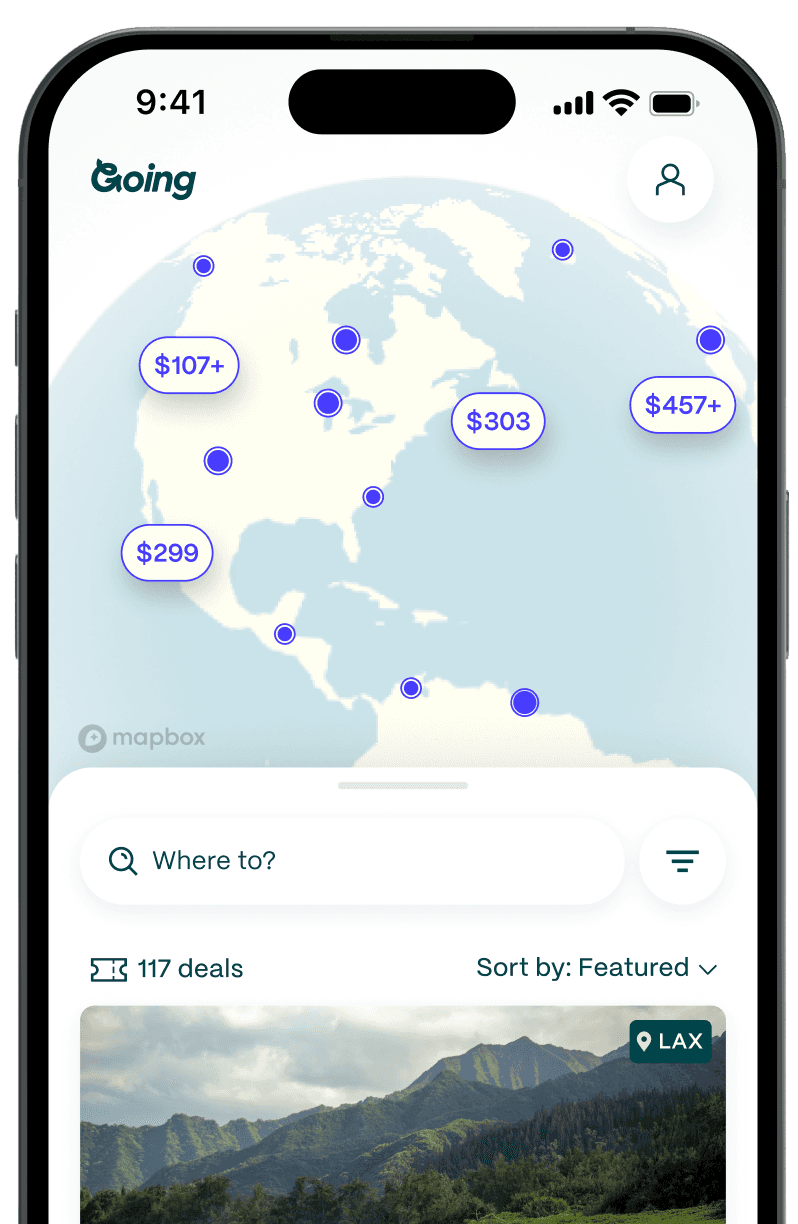
Going monitors thousands of routes around the clock and only alerts you when fares are worth booking, not just slightly lower than yesterday.
A Limited membership covers continental US routes. Premium members unlock international deals and mistake fares, which can run 50–90% below the normal price. Elite members get all of that, plus deals in premium cabins. Members save an average of $200 per domestic flight and $550 on international flights.

Google Flights
Fast, ad-free, and comprehensive. Use the calendar view to find the cheapest dates on a specific route, the Explore map to discover cheap destinations when you're flexible, and the Track Prices toggle to get email alerts for a route you're watching.
Limitation: It won't alert you to deals on routes you haven't searched, and its bar for what counts as a "deal" is higher than specialized tools, like Going.
Learn the shortcuts in our guide on how to use Google Flights.
Skyscanner
Skyscanner casts a wider net and includes the "Everywhere" search feature for travelers with no fixed destination. It's also useful for its Mix & Match option, which combines separate one-way tickets to find cheaper roundtrip combinations.
Momondo
Scans lesser-known travel agencies that Google Flights and Skyscanner sometimes skip. It’s worth a quick check on expensive international routes where a small agency might have a lower-contracted fare.
How to use them together: Set a Going flight alert for your target destination. Use Google Flights to research date flexibility and nearby airports. Cross-check with Skyscanner if budget airlines are relevant. Book directly with the airline when possible to simplify changes and refunds.
Simple ways to lower your fare
Shift your dates by 1-2 days
Tuesday, Wednesday, and Saturday departures are reliably cheaper than Friday or Sunday. On a typical international roundtrip route, moving your outbound flight from Friday to Wednesday can save $80–$150 with no other changes. Use Google Flights' calendar view to see the price difference at a glance.
Check alternate airports
A nearby secondary airport can undercut the main hub, especially where a budget carrier operates. Weigh the fare gap against the cost and time of getting to and from the alternate airport.
Take routes with a layover instead of flying nonstop
Nonstop is convenient, but a single connection frequently costs less. If there is a noticeable fare gap and the layover is reasonable, it can be an easy trade for some travelers.
Calculate the real cost of budget airlines
A low base fare can evaporate once you add bags and seat selection. Add up carry-on, checked-bag, and seat fees before comparing a budget fare with a standard one that includes them.
Act fast on airline sales
Sale fares and mistake fares disappear quickly, so when you find a good price, book it. The 24-hour rule gives you a day to sort out logistics without losing the fare. In other words, book, plan, and cancel if you need to. For more tactics, see how to find cheap flights.
Get alerts to price drops with Going (before and after you book)
Don’t miss out on the next flight deal. Going does the watching for you, tracking your routes and sending an alert the moment a fare is worth booking. Going even tracks fares after you've booked, so you can rebook for a refund or credit. Set your home airports, tell us where you want to go, and let the deals come to you.
Frequently asked questions
Why are flights so expensive in December?
How early should I buy plane tickets?
Should I book my flight now or wait?
How do I know if a flight price will go down?
How likely is it for flight prices to drop?
How risky are last-minute flight deals?
When do flight prices drop?
When are flights cheapest to book?
Will flight prices go down if I wait?
What time do flight prices drop on Tuesday?
Last updated September 23, 2026
Articles you might like
View All