

)


Table of Contents
There’s no single date or magic rule that answers “book now or wait” for every trip. What exists is a framework. Everyone's been there: You find a fare. It looks fair, maybe even good. Then the doubt creeps in: What if it drops next week? Or what if you wait, and it climbs by $200 instead?
Knowing when to make the call comes down to a few things: whether your dates are locked in, how flexible you are, how far out you are traveling, and whether you are flying during a busy stretch.
This guide walks you through that framework, so you can decide with confidence instead of refreshing the same search for a week. Let’s figure out which situation you're in.
Key takeaways
- If your dates are fixed and you are inside the Goldilocks Window, book once the fare looks reasonable. Waiting usually means paying more, not less.
- If your dates are flexible, you can afford to watch and wait. Set a price alert so you know when a fare drops below what is normal for your route.
- If you are flying during a holiday, a major event, or peak season, book as soon as you see a reasonable fare. Last-minute discounts on high-demand dates are rare.
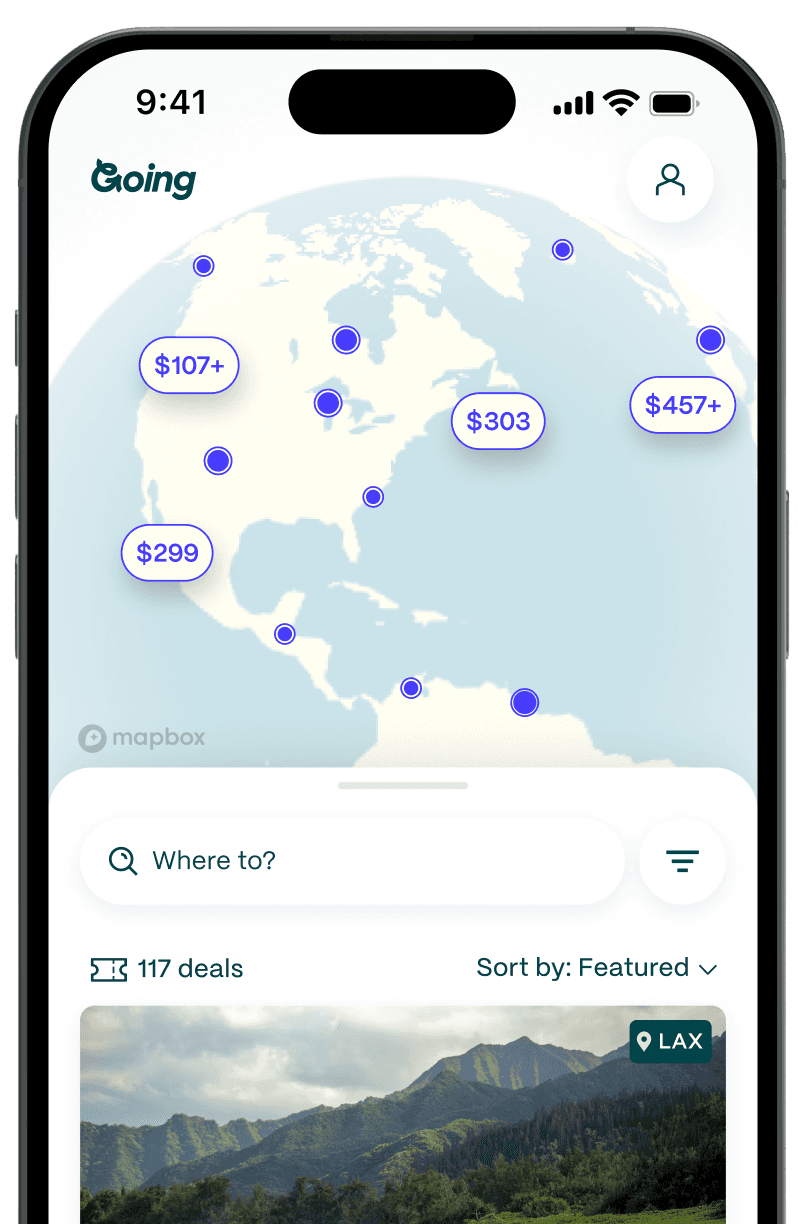
- Not sure whether the fare in front of you is actually a good deal? Set up a trip in the Going app, and we'll flag when a fare is worth booking. Price Drop keeps watching it afterward so you can rebook if it falls.

What you need to know first
Airfare usually climbs as your departure date gets closer, but not always, and not on a fixed schedule. As a general rule, booking well ahead of your trip tends to cost less, while cutting it close tends to cost more. There is a stretch where prices sit at their friendliest—what we call the Goldilocks Window—and once you are past it, the odds tilt toward higher fares.
That said, prices can still dip. Airlines run fare sales and adjust their seat inventory constantly, so a fare can slide for a few days even close to departure. A price that looks high today on one route can be perfectly normal on another, which is why comparing against the typical range for your specific route tells you more than the calendar does. That is also why “book now or wait” feels so slippery: The general pattern points one way, but there are definitely exceptions. Those exceptions are what keep you second-guessing.
So the useful question is not “will prices go up or down,” which nobody can promise. It is “does my situation favor booking or waiting?” For the deeper patterns behind when flight prices actually drop, we have a separate guide. Here, the goal is to help you make the call for your own trip.
Fixed dates or flexible?
This is the fork in the road, and it decides most of the answer. If your dates are locked, say you are flying for a wedding on a set weekend, you don't have the luxury of traveling a week earlier or later if a cheaper travel day appears. Your job is to book when the fare looks reasonable for that route because holding out mainly exposes you to a price hike with no backup plan.
If your dates are flexible, you have a bit of leverage. You can shift a departure by a day or two (or even a week or two), keep an eye on a couple of routes, and jump when something drops. A midweek flight instead of a Sunday one, or leaving a day earlier, can be the difference between two very different prices on the same trip.
In both cases, setting up a price alert is the smart first move. This keeps you on top of fare movements on your route instead of guessing, and you will recognize a good price when you see one. If you want to line your dates up with the cheaper patterns, our guide on the best time to book a cheap flight goes deeper.
How far out are you? Lead time matters
The Goldilocks Window is the timeframe when flight prices are at their lowest before rising closer to departure. As a rule of thumb, it points to these ranges:
- International trips: book roughly 2 to 8 months before departure. For peak-season international travel, widen that to about 4 to 10 months, as the best seats on popular dates go early.
- Domestic trips: 1 to 3 months out is the sweet spot. For peak-season domestic travel, push it to about 3 to 5 months.
Whatever the route, fares reliably rise around 21 days before departure, then again near 14 days and 7 days out, because of airlines' advance-purchase pricing. Once you are inside 21 days, booking sooner beats waiting.
Sadly, even inside these windows, a given fare can sit above the route’s average. That is where a price alert earns its keep. Set up a trip in the Going app. We'll watch your route and tell you when a fare is actually worth booking, based on historical fare data, so you are not just guessing.
→ For a deeper look at timing, see how far in advance you should book a flight.
Flying during holidays or peak season? Don’t wait
When demand is high, the whole calculation changes. Thanksgiving, the winter holidays, spring break, big festivals and conferences, peak summer flights to Europe, peak winter escapes to the Caribbean: On dates like these, seats fill up, and airlines have little reason to discount at the last minute. They know those seats will sell, so the incentive to run a sale simply is not there. If you see a reasonable fare, take it.
The booking windows also open earlier. As the lead-time ranges above show, peak-season trips are worth shopping several months ahead. The exact dates shift from year to year, but the principle holds: For popular travel periods, earlier is the safer play.

Traveling off-peak? You have more opportunity
If you are traveling in a shoulder month or a low-demand stretch, airlines sometimes trim fares to fill seats, and sales turn up more often, so you have more chances at a deal and a little more room to wait for one. That said, if a great fare shows up, there is no prize for waiting. Book it.
Do flight prices really jump as departure gets closer?
Mostly, yes. Fares reliably increase around 21 days before departure, then again near 14 days and 7 days out, on both domestic and international routes. That pattern comes from airlines' advance-purchase pricing. The cheaper fare buckets close at those cutoffs, so the same seat costs more as each one passes.
Routes with a lot of business travelers, who tend to book late and pay more, usually show the climb most sharply, while leisure-heavy routes can stay softer for longer. Red-eyes and awkward connections also hold their prices down better than the convenient nonstops that everyone wants.
But this rule is not set in stone. A quiet route can see a last-minute inventory dump, and a fare war can knock prices down for a few days. So while the 21-day, 14-day, and 7-day step-ups are dependable, there are exceptions.
Overall, the takeaway is simple: The closer you get to departure, the riskier waiting gets. This is the time for action.
How to take the guesswork out of booking
Here's the thing about “book now or wait.” The whole dilemma exists because no one can see the future. You book, and then you spend the next month half-hoping you didn't overpay. It's a quiet little tax on your peace of mind.
Set up a trip in the Going app for the routes you care about, and we'll watch fares for you and let you know when a deal is worth booking. That way you're booking on data rather than on a hunch.
Once you’ve booked, Price Drop is an extra safety net. It keeps monitoring your fare from the moment you book until you depart, and if the price falls, it tells you so you can rebook for less.
Let our alerts take the weight out of finding the best deals for your flight.
Checklist: Should you book now or wait?
When you are ready to make the call, run your trip through these quick scenarios.
- Fixed dates, inside the booking window, and the fare looks fair: book now.
- Flexible dates and off-peak travel: set up a price alert and wait for the right deal.
- Peak season or a major event, and the fare looks reasonable: book now.
- Very far out, beyond the window, for a domestic trip: wait, have an alert tracking prices for you.
- Inside 21 days of departure, with the advance-purchase cutoff approaching: book now.
Even when a scenario points to booking now, a fare can still be above-average for the route, so it's worth having a price alert running so you can act the moment a good one appears.
And if more than one line fits your trip, lean toward booking. The cost of losing a good fare is usually higher than the cost of booking and watching for a dip.
Frequently asked questions
Is it a good idea to book flights right now?
Should I buy a flight ticket now or wait?
Do flight prices really go down on Tuesday?
Is it a good time to book a flight today?
Last updated September 23, 2026
Articles you might like
View All
How To Get Notified When Flight Prices Drop (Even After You Book)
Sep 23, 2026
5 min read

Booked a Flight, Then the Price Dropped: Your Action Plan
Sep 23, 2026
3 min read

Best AI Tools for Finding Cheap Flights and Catching Price Drops in 2026
Sep 23, 2026
11 min read