Best AI Tools for Finding Cheap Flights and Catching Price Drops in 2026



September 23, 2026
11 min read
Table of Contents
Booking a cheap flight used to mean opening a dozen browser tabs, refreshing prices for a week, and second-guessing yourself right up until you hit “purchase” (and probably second-guessing yourself after too).
Nowadays, artificial intelligence promises to do a lot of that work for you. Type “a week somewhere warm in March, nonstop, under $500,” and the right tool will hand you a list of options in seconds.
That’s the promise, anyway.
Some AI flight tools are great at surfacing ideas and predicting price moves, but others confidently invent fares that don't exist. And the cheapest flight an algorithm shows you might not always be the cheapest flight out there.
We compared the eight tools travelers ask about most, so you know exactly what each one is good at, where it falls short, and how to combine them to actually save money.
Key takeaways
The best AI tool for cheap flights depends on your goal: searching, predicting, or planning. Here’s the quick verdict, by category.
The best AI tools for finding cheap flights in 2026
- Best overall AI flight scanner: Google Flights AI Deals for natural-language search across hundreds of airlines, free (still in beta).
- Best AI-powered comparison site: Skyscanner has the widest airline and budget-carrier coverage, plus Explore with AI.
- Best AI price prediction: Hopper has buy/wait calls and Price Freeze (predictions are self-reported, not guaranteed).
- Best all-in-one search engine: Kayak offers one of the largest range of filters, Price Forecast, and Hacker Fares.
- Best for creative and hidden-city routing: Kiwi.com has virtual interlining and Nomad (self-transfer and "Smart Ticket" risks apply).
- Best for conversational trip planning: Claude, ChatGPT, and Gemini work fine for itineraries and fare rules, but verify every fare, as they often hallucinate.
- Best for human-vetted deals at the best price every time: Going, which is not an AI tool. Human Flight Experts hand-check every fare, so there’s nothing for you to double-check.

How AI is changing the way we find cheap flights
For years, flight search worked one way: You told a site exactly where and when you wanted to go, and it showed you prices. But the cheapest trips often come from being flexible, and rigid search boxes don’t really allow flexibility.
AI flips that. Instead of forcing you to know your destination, today's tools let you describe a vibe (like “somewhere with great food and no layovers”) and work backward to the deals.
These tools can also read billions of historical price points to guess where fares are heading, so you’re not booking without any context.
What AI hasn’t changed is the fine print. A scanner can show you a $300 fare, but it won’t tell you whether the airline reroutes you for free when your connection collapses, or whether that “deal” is actually a bad price dressed up nicely.
The smartest way to use these tools is to let them inspire and inform you, then confirm the details yourself before you pay.
The 8 best AI tools for finding cheap flights in 2026
1. Google Flights AI Deals: Best overall AI flight scanner
Flight Deals is Google’s AI-powered search inside Google Flights. You describe your trip in plain language, and it reads real-time fares across hundreds of airlines to surface the best-priced matches, ranked by how much you save.
It launched in beta in August 2025 for the US, Canada, and India, then expanded to more than 200 countries and 60-plus languages in November 2025.
Because Google has the largest flight inventory of any scanner, when it finds a deal, it’s pulling from a deep well.
It’s not a magic tool:
- It's still in beta. If your dates and destination are locked in, you’ll get more from regular Google Flights.
- Testers found that “5-day winter trip” returned nothing while “week-long winter trip” returned several options. Small phrasing changes shift results.
- Google’s bar for a “deal” is higher than a specialized service’s.
Best for: Brainstorming flexible, budget-driven trips when you're open to where you land.

2. Going: Best for a human touch and knowing you’re getting the best deal every time
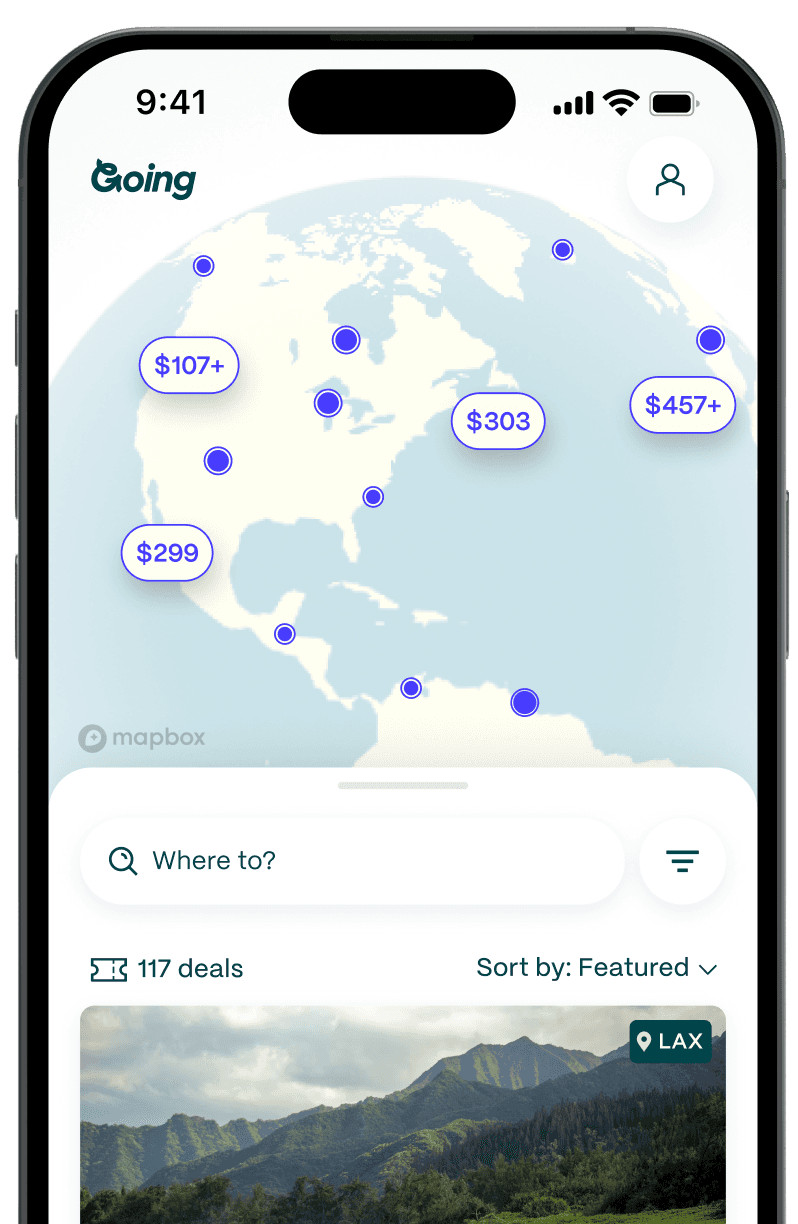
Alright, elephant in the room: Going isn’t an AI tool. While most platforms lean on algorithms to surface “deals,” Going pairs internal technology with a team of human Flight Experts who hand-check every fare before it reaches members.
AI gets fares wrong all the time, so a human touch is crucial to ensure you don’t click through from the deal and wind up disappointed.
The average deal Going sends is cheaper than roughly 95% of all fares available on that route, and members save an average of $200 on domestic tickets and $550 on international ones.
With Going’s Price Alerts, you can set up a Trip knowing either when you want to travel, where you want to travel, or both, and it surfaces deals to fit your preferences. Once you’ve found and booked your dream deal, Going’s Price Drop feature continues to monitor your fare, so if the price drops, you’re able to reclaim the difference.
Best for: Travelers who want to feel confident they’re getting the best deal every time because deals are vetted by a team of Flight Experts and delivered right to their phone or inbox.
3. Skyscanner: Best AI-powered flight comparison site
Skyscanner has long been a favorite for its breadth of airline coverage, including budget and regional carriers that bigger names skip.
In 2026 it leaned into AI with Explore with AI, which lets you search conversationally and returns recommendations alongside pricing, weather, and timing context, plus prompts like “September is typically cheaper than December.”
Best for: Wide coverage of airlines and budget carriers, plus AI-assisted destination inspiration.
4. Hopper: Best AI price prediction
Hopper built its name on one question: Should I buy now or wait? Its app reads huge volumes of historical fare data and gives you a "Buy” or “Wait” recommendation, claiming 95% accuracy on whether a price will rise or fall.
Travelers have been burned when a “wait” call backfired and prices climbed. Predictions are a helpful guide, not a guarantee.
For more on the trade-offs, see our full guide on how to use Hopper.
Best for: Deciding when to book a trip you’ve already chosen, and freezing a price when you need a few days to commit.
5. Kayak: Best all-in-one flight search engine
Kayak is the Swiss Army knife of flight search. Alongside one of the industry’s deepest filter sets (cabin, alliance, layover length, total travel time), it offers a Price Forecast that gives a buy-or-wait verdict on roundtrip searches, an Explore map that shows where you can fly within a budget, and price alerts that ping you when fares move.
Its standout trick is Hacker Fares: Kayak stitches together two separate one-way tickets, often on different airlines, when that combination beats every roundtrip price. It can save you some serious money, but it comes with a catch.
Because the two tickets aren’t linked, there’s no through-baggage agreement, and if your first flight is delayed and you miss the second, the airline owes you nothing.
Best for: Power users who want lots of filters, solid price predictions, and creative roundtrip pricing in one place.
6. Kiwi.com: Best for creative and hidden-city routing
Kiwi.com finds routes nobody else shows you. Its "Kiwi-Code" engine specializes in virtual interlining (which Kiwi calls self-transfer): It combines flights from airlines that don’t normally cooperate, like pairing a budget carrier with a long-haul one, to build cheaper itineraries.
Its Nomad tool takes a list of three or more cities and finds the cheapest order to visit them, a time-saver for multi-stop trips.
With virtual interlining, Kiwi’s terms note that you’ll need to collect and re-check your luggage at each layover and clear customs yourself, and because the flights are separate bookings, you're not automatically protected the way you would be on a single-carrier ticket.
Kiwi also surfaces hidden-city and throwaway fares, which it labels "Smart Tickets." These can be cheap, but airlines actively try to prevent the practice and write restrictions into their conditions of carriage, so use them with open eyes and carry-on only.
Best for: Flexible, adventurous travelers chasing the lowest possible fare on complex or off-the-beaten-path routes.
7. ChatGPT: The AI tool we all know
ChatGPT is the AI most people use on a daily basis, and for trip planning it can be useful. For finding and booking flights, it's a different story.
On its own, ChatGPT can’t access live fares, so it tends to quote prices that don’t exist or invent impossible connections. OpenAI's agent features (and its Atlas browser) can open Skyscanner, Google Flights, and Kayak and read them, which helps.
Still, a 2026 test still found the agent identified the cheapest fare only about two-thirds of the time, and it couldn't complete a booking because checkout steps require verification it can't pass.
There are documented cases of travelers being denied boarding after ChatGPT gave them the wrong visa information.
Overall, use it for ideas, but verify every fare, baggage rule, and entry requirement against the airline or an official source.
Best for: Itinerary ideas and trip structure, with mandatory fact-checking before you book anything.
8. Claude and other LLMs: Best for conversational trip planning
Claude, Gemini, and other large language models work great at the reasoning side of travel: comparing itineraries, decoding confusing fare rules, explaining baggage fees, or talking through whether a long layover is worth the savings.
Gemini has an edge on live prices because it pulls from Google Flights inventory. Claude is built to decline inventing fares rather than guess, which makes it reliable for planning but not for real-time pricing.
The common thread across every LLM is simple: They aren’t always factually correct.
Even the best models make things up a small percentage of the time, and for fast-changing data like fares and travel policies, “a small percentage” can mean something in your trip will be off.
Best for: Conversational planning, comparing options, and understanding the rules, paired with a real booking tool for the actual fare.
AI flight finder comparison: features, pricing, and best use cases
| Tool | AI feature | Price prediction | Best for | Free? |
|---|---|---|---|---|
| Going | Human Flight Experts + proprietary technology | Price Alerts, Price Drop (book, wait, or reclaim money on a booked flight based on price history) | Human-vetted deals on average 40–90% off | Free Limited tier; paid Premium/Elite |
| Google Flights | Natural-language Flight Deals search | Yes (Price Insights, Price Graph, Price Guarantee) | Flexible, exploratory budget trips | Yes |
| Skyscanner | Explore with AI, Savings Generator | Price calendar and savings insights | Broad airline coverage and inspiration | Yes |
| Hopper | Buy/Wait price prediction | Yes (claims 95%, self-reported) | Timing a booking; freezing a price | Free app; optional paid add-ons |
| Kayak | Price Forecast, Explore map | Yes (buy/wait on round trips) | All-in-one search, Hacker Fares | Yes |
| Kiwi.com | Kiwi-Code virtual interlining, Nomad | Price alerts | Creative routing and multi-city trips | Yes; paid protection add-ons |
| ChatGPT | Conversational, agent/Atlas browsing | No (can’t reliably access live fares) | Itinerary ideas (verify everything) | Free and paid tiers |
| Claude/Gemini | Conversational planning | Varies (Gemini pulls from Google Flights) | Planning, fare-rule questions | Free and paid tiers |
How to use AI to find the best airfare prices
AI can help you pay less for your flights. The key is remembering that with every AI tool, the work doesn’t end when the results appear. Here’s a realistic rundown of how to use them:
- Start broad. Use Google Flights’ Flight Deals or Skyscanner’s Explore with AI to find destinations and rough prices that fit your budget and dates.
- Pressure-test the price. Run a Hopper or Kayak Price Forecast to see whether fares are likely to rise or fall, so you know whether to book now or wait.
- Cross-check the fare. Look up the same route on a second tool and on the airline's own site. AI results can be stale or simply wrong.
- Confirm the details. Baggage allowance, layover length, change rules, and (for international trips) visa or entry requirements. This is where AI often slips up.
- Book directly when you can. Booking with the airline usually means cleaner refunds and easier rebooking if something goes wrong.
Notice how many of those steps are you checking the AI's work.
That extra work of research and confirmation is the real cost of using these tools, and it's exactly the step Going removes.
Stop double-checking the robots. Join Going, and let Flight Experts send you deals, so the only decision left is where to go.
Pro tips to maximize savings with AI flight finders
Set up smart fare alerts on every tool you use
Prices move constantly, and the cheapest fares vanish fast, sometimes within hours. Turn on alerts wherever you can: Going Price Alerts, Google Flights price tracking, Kayak Price Alerts, Skyscanner's DROPS, and Kiwi's route alerts.
For deals you’d never catch on your own, layer a Going membership on top so a human is watching your home airports for deals for you.
Use “explore anywhere” and flexible-date AI features
The biggest lever on price is flexibility. If you can shift your dates by a few days or stay open on the destination, tools like Skyscanner's Everywhere search, Kayak's Explore map, and Google's Flight Deals will likely find lower fares than a fixed search.
Travel in the shoulder season (the weeks between peak and off-peak), and you’ll often pay far less and have a little more elbow room.
Combine AI tools with loyalty programs and credit card rewards
Once an AI tool finds you a route, check whether it’s cheaper in points. Airline loyalty programs and transferable credit card rewards can turn a $1,200 international ticket into a few thousand points plus taxes.
AI is bad at award pricing, so this is a manual check, but it’s often where the biggest savings hide.
Is Skiplagged legit? And other money-saving hacks
Skiplagged surfaces hidden-city fares, where a flight with a layover in your real destination is cheaper than a direct ticket there, so you simply get off at the layover and skip the final leg.
While using it isn’t illegal, airlines explicitly prohibit it in their conditions of carriage.
The downsides: You can’t check a bag (it flies to the final city), you can only do it on the last leg, and frequent use can get your frequent-flyer account or future bookings canceled.
Other hacks worth knowing:
- Mistake fares (an airline pricing error, rare but huge)
- The US Department of Transportation’s 24-hour rule (book a refundable hold and cancel within 24 hours if plans fall through)
- The Goldilocks Window (booking domestic flights about 1–3 months out and international flights 2–8 months out).
Ready to stop searching and start packing? Join Going, and get cheap flight deals from your home airports, hand-picked by human Flight Experts, no algorithm or guesswork required.
Frequently asked questions
What is the easiest way to find cheap flights?
How to get 50% off on flight tickets?
Which is the best website to book the cheapest flights?
Is there a website that tracks cheap flights?
Which day of the week is cheapest to buy flight tickets?
How to predict if flight prices will drop?
Last updated September 23, 2026
Articles you might like
View All